Menu

Close
Twenty years ago, we said yes.
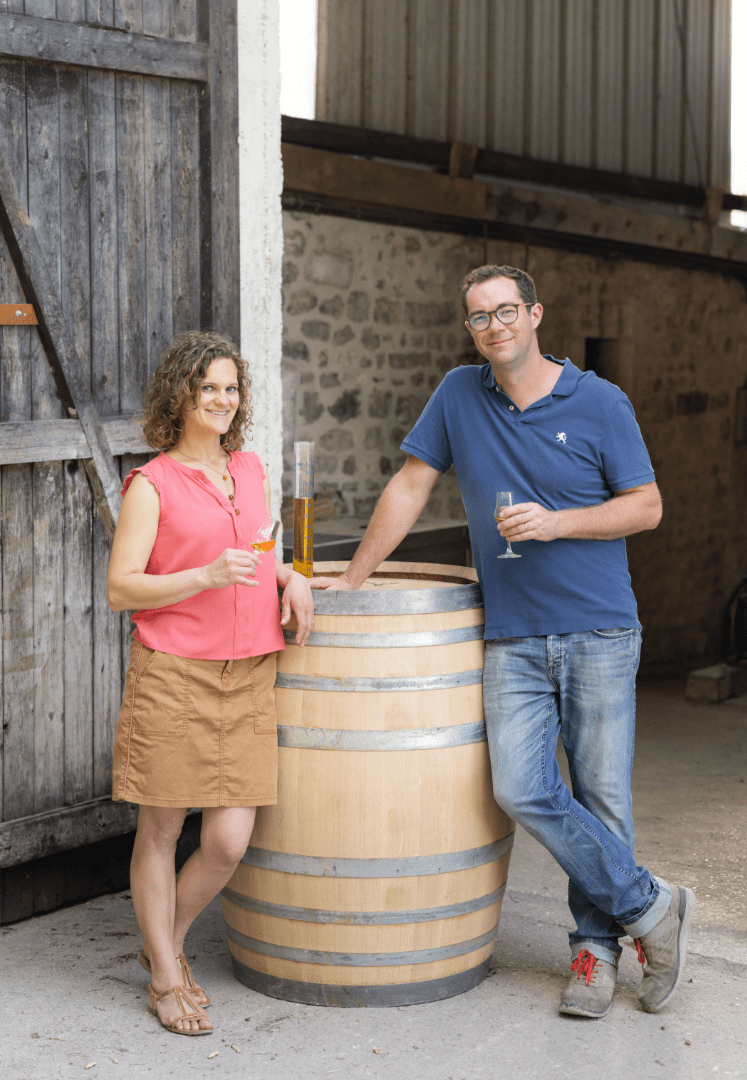
Twenty years after our wedding in Eraville, I (Amy) look back at the year that shaped both our family and the future of Pasquet Cognac: 2006, the year we chose independence.
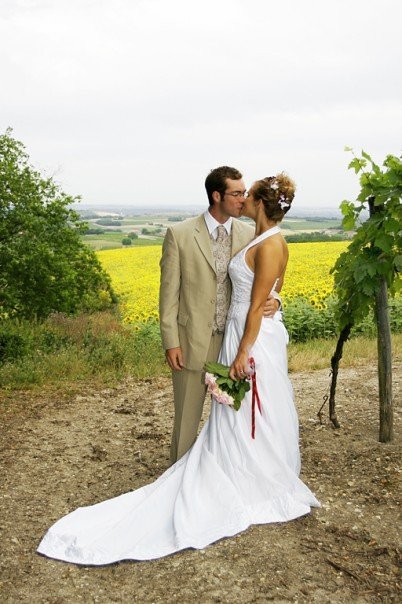
Twenty years ago, we said yes.
By Amy Pasquet — Eraville, Grande Champagne, 2026
In July, the sunflowers bloom around our estate in Éraville.
They face the sun the way Van Gogh painted them in the south: not decorative, not arranged, just gloriously, stubbornly alive. Twenty years ago this summer, Jean and I married here, under the live oak trees, with the sunflowers watching. The estate was his family’s. The old stone houses, the Charente archway over the main entrance, the chai where his father Jean-Luc had been making cognac since 1970 (at first entirely for others, then under the Pasquet name from 1977 on) all of it centuries old, patient, rooted.
I had arrived in France on a Fulbright scholarship, a girl from a dry county in North Carolina with a head full of ideas about what her life was supposed to look like.
It did not look like this.
And then it did.
That same year, in 2006, something else happened. Something quieter than a wedding, less celebrated, but perhaps equally consequential for what our life together would become.
Jean-Luc decided to stop selling bulk spirit.
To understand why that matters, you need to understand how the cognac business worked, and mostly still works.
Small producers like us grow the grapes, distil the wine into eau-de-vie, age it in oak, and then often sell a significant portion, if not all, of that production in bulk to the famous houses. They, in turn, blend it, bottle it, market it, and sell it to the world under their own names. The small producer gets a predictable income. The house gets its volume. Everyone understands the arrangement.
But the arrangement has consequences.
The quota system is likely one of the least understood parts of Cognac. Each year, the amount of pure alcohol producers are permitted to produce per hectare is set according to the anticipated needs of the market; needs largely shaped by the houses that represent most of the volume sold. That global figure is then divided across the number of hectares planted in the appellation.
In practical terms, this means that a small grower’s production is not simply determined by the quality of the harvest, the capacity of the estate, or the number of people waiting for bottles with that grower’s name on them. It is determined by a collective calculation driven by the expected demand of the whole category.
In 2006, that number was low, as it had been for much of the recent past.
Jean-Luc therefore found himself having to ration his own cognac. He could not fill every order. His export clients, independent distributors and specialist retailers in Germany, the United States, Belgium, and Japan, people who had sought out Pasquet specifically, who wanted his cognac in the bottle and his name on it, were waiting.
And the bulk buying system was waiting too.
He chose his clients.
He said he would rather fill a Pasquet bottle than an anonymous cask.
So he stopped the contract. No drama, no manifesto, no business plan. Just a quiet, clear decision about whose name mattered, and whose hands he trusted with what he made.
I want to be clear about what that decision has cost us and how it has benefited us, because the honest version is more useful than the heroic one, and because I am not writing this to crow about a choice that turned out well. I am writing it twenty years on, in the middle of a crisis that is devastating people we know and love, and I am genuinely uncertain whether we were wise or simply fortunate.
It has cost us security. The bulk contract was predictable revenue. Walking away from it meant betting entirely on our own brand, our own relationships, and our own ability to find the right people in the right markets who would pay for a bottle with our cognac inside and our name on the outside. In 2006, that was not a certain bet. There are years when it is still an uncertain one.
It has cost us scale. Our estate counts only fifteen hectares. We are subject to production caps that limit how much spirit we can distil per hectare, which means our costs per bottle are structurally higher than those of a large-scale producer. We cannot compete on price. We never could.
We have always had to compete on something else.
What it has given us is harder to quantify and, at the same time, more important.
It has solidified our identity.
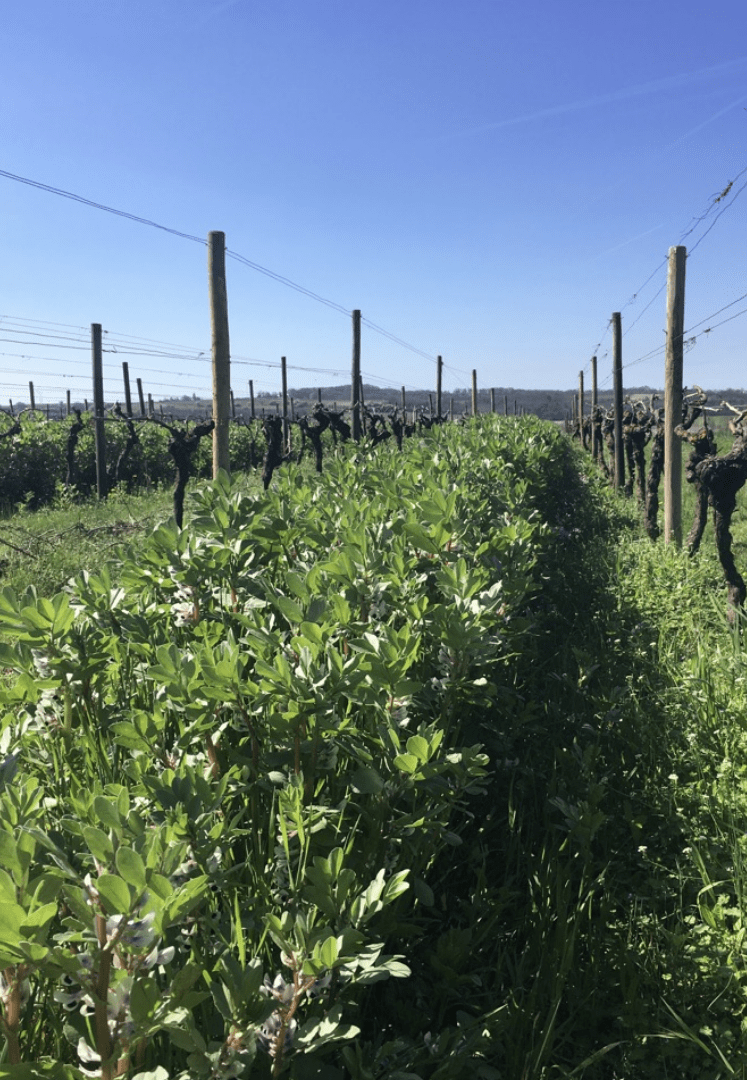
For us, it seems nearly impossible to toe the line between being both an artisan and an anonymous supplier. The moment you choose independence, everything else has to become consistent with that choice: the organic certification we have held since 1998, the native yeasts, the hand bottling, the absence of additives, the Trésors de Famille collection of rare aged expressions that exist because we kept them rather than sold them into someone else’s blend.
None of it would mean anything if we were still filling anonymous barrels.
The 2006 decision made all of it coherent.
It gave us relationships that cannot be bought.
It has brought us to know growers and distillers who have opened their cellars to us, not because we are large or powerful, but because we understand what it means to work at their scale. It has brought us families whose stories have become part of our own, casks tasted at the end of long conversations, tables where the bottle is never just a bottle, but a way of saying: this is where I come from, this is what I have conserved, this is what I am ready to share.
It has brought us to know fellow spirits lovers from far beyond Cognac: people who come from whisky, rum, bourbon, armagnac, and wine; people who arrive curious, sometimes skeptical, and become friends. It has brought us drams shared in bars, warehouses, cellars, living rooms, tasting rooms, and late-night conversations where no one is trying to sell a luxury object, only to understand what is in the glass.
It has brought us to know independent bottlers, private clients, sommeliers, wine merchants, importers, writers, artists, collectors, and enthusiasts who care enough to look closely.
You have to be the real thing for them.
The people who have found us arrive from far and wide. Many come from whisky, rum, and bourbon, as the internet has allowed knowledge to travel faster and the categories have begun to overlap. Forums, blogs, independent bottlers, specialist merchants, wine shops and sommeliers have helped people become more curious. Whisky drinkers have started tasting old rum. Rum drinkers have found armagnac. Sommeliers have begun to look at spirits not as luxury objects, but as agricultural products with origin, craft, time and texture.
Some of them have found cognac.
There is something almost poetic in that. One hundred and fifty years ago, phylloxera devastated the vineyards of Cognac and helped open doors for whisky that brandy had once kept guarded. Perhaps today, as whisky drinkers and spirits lovers turn their curiosity back toward cognac, they are simply returning the favor.
We have seen this through WhiskyFun, through The Sponge, through Wu Dram Clan, through Serious Brandy, through Christian Dully, through Swell de Spirits and independent bottlers, private clients, and people who started out simply wondering whether cognac might contain more than the image they had been sold.
They are not casual consumers. They are people who have grown tired of the performance of luxury and gone looking for the real thing. They care about what is in their glass, who made it, how it was grown, how it was distilled, whether anything was added, and whether the story holds together once you look closely.
That is why their trust matters so much to us.
We did not plan this community. I am fairly certain that it could have been planned. You cannot manufacture the confidence of people whose entire value system is built on detecting inauthenticity. You can only be who you are, make something true, and do your best to make sure they can find you.
We are still working on that finding part.
I should say something about what is happening in our region right now, because the story would be incomplete without it.
The cognac category is in serious crisis. Volume sold has fallen by more than a third in three years. The large houses are cutting contracts and laying off staff. Growers are being paid to pull out their own vines. And it is not strangers who are struggling. It is our neighbours. Our friends. Families whose knowledge of these specific vines, this specific soil, this specific art of distillation, is ancient and irreplaceable and genuinely at risk.
I do not write any of this with satisfaction. The knowledge that lives in the hands of a Charentais grower who has tended the same parcels for forty years — that knowledge has taken generations to build and can be lost in one.
What is happening here is not just an economic correction. It is a cultural rupture.
Over time, the structure of cognac rewarded volume more than identity. It made anonymity feel rational. It encouraged growers to become suppliers rather than names, to measure security in contracts rather than relationships, and to let others carry the story of what they had made.
For many families, that system worked. Until it no longer did.
And while it worked, something precious was being weakened. Cognac is one of the world’s great agricultural spirits: grown in specific soils, distilled by people who know their wines, aged slowly in cellars whose conditions cannot be copied, shaped by families who carry knowledge in their hands, noses, memories and habits.
But too often, the system pushed that reality into the background. It taught the world to see Cognac first as luxury, status, category, label, blend — and only afterwards, if at all, as farming, distillation, patience, origin and craft.
That is not a small loss.
When the person who grows, distils, ages, and understands the spirit becomes invisible, the drink itself becomes easier to misunderstand.
I also do not know, with any certainty, that we made the right decision in 2006. We made a decision. And I learned a long time ago that you cannot plow a straight line looking behind you. We are living our choice fully and I do believe that it has brought us to where we are now: still standing, still independent, still with our name on every bottle, and Jean-Luc still here to see it.
Whether that makes it right, or whether it makes us lucky, I honestly cannot say.
We are in our twentieth harvest free from the system.
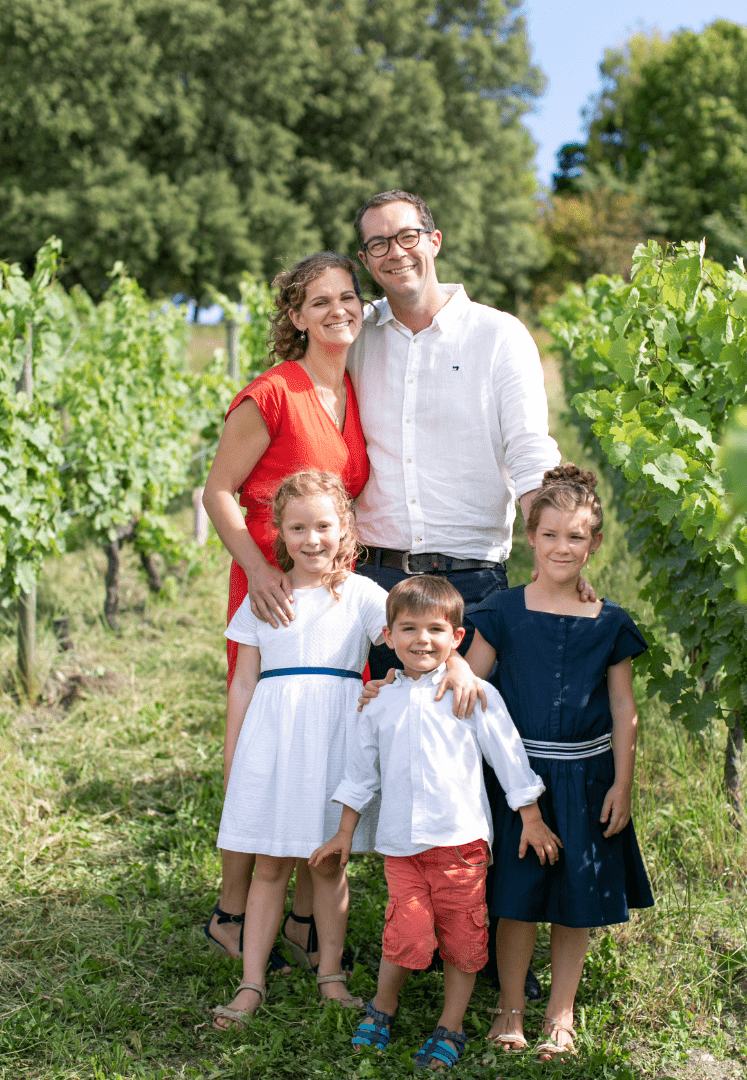
Jean and I will celebrate twenty years of marriage this July under the same live oak trees where we stood in 2006, with the sunflowers watching. Our three children are growing up on this estate, in these stone houses, under the Charente archway, learning without knowing they are learning what it means to tend something old and make it last.
Next year, we will celebrate fifty years of Pasquet Cognac. Nearly fifty years of our name on bottles. Twenty years of full independence. Those are not the same milestone, but they do belong to the same story.
When I look back, I do not think we understood what we were saying yes to.
We said yes to each other, of course. To a life neither of us could have fully imagined. To love, children, weather, harvests, paperwork, risk, beauty, fatigue, tastings, bottlings, mistakes, repairs, late invoices, old cellars, new markets, long dinners, hard years, and the strange privilege of belonging to a place that asks a great deal of you.
But without knowing it, we also said yes to independence.
To staying organic.
To putting our name on what we make.
To choosing relationships over volume.
To keeping the agricultural, hand-crafted reality of Cognac visible.
To finding the people who actually want what we actually make — in our shop, at our estate, through our website, through importers who believe in us, through wine merchants, sommeliers, independent bottlers, enthusiasts, private clients, and friends who have become part of the story.
To making sure our children have something worth inheriting.
That is enough.
That is, in fact, everything.
If you find yourself curious about what this tastes like, you know where we are.
— Amy Pasquet
Pasquet Cognac has been produced in Eraville, on the border if Grande and Petite Champagne, since 1977. The estate dates back to 1715. We have been certified organic since 1998. We would be so glad to hear from you if you would like to visit.